Coalition: How last-minute entreaties to Obi, Kwankwaso failed -ADC stakeholder
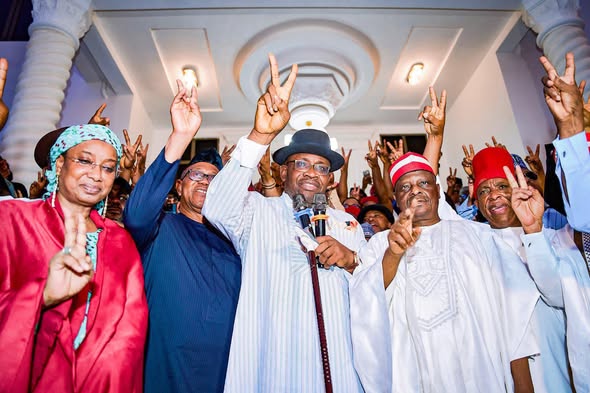
NDC receiving Obi and Kwankwaso
Emeka Agu (with agency reports)
Twenty-four hours after the resignation of Peter Obi and Rabiu Kwankwaso from the ADC facts have merged on how last-minute persuasion by ADC stakeholders to keep the duo in the fold failed.
An ADC insider who spoke with The Daily Monitor said all entreaties were made towards retaining the duo, but every effort failed. According to him, several offers and power concession deals were made but it did not go down well with them as they insisted on direct primaries as against consensus. “Of course, the defection did not go down well with a lot of our stakeholders. It was not an easy bite for us. While everyone has the right to contest, several concessions were made to Obi, including the fact that Atiku would do a first term and hand over to Obi, who would return Nigeria to one term of 5 years scheme as suggested by Goodluck Jonathan. These were the options on the ground for Obi, but it did not go down well with them. They objected to consensus arrangement. They wanted direct voting”, said the inside source.
Recall that Obi joined the ADC early 2026 while Kwankwaso joined the party in April 2026.
The duo made the declaration after being received at the national Secretariat of the party by NDC National Leader, Sen. Seriake Dickson on Sunday in Abuja.
They called for national unity, youth empowerment and an end to internal political crises.
They noted that the call formed part of efforts to reposition Nigeria for sustainable development.
Kwankwaso commended the party’s leadership for its vision and commitment to national development.
“I sincerely appreciate you for taking the time to explain so many things about this party. I also congratulate you on your commitment to this country and the quality of leadership you represent,” he said.
He said the visit was to familiarise themselves with the party’s ideology, blueprint and core values, noting that discussions revealed shared priorities, particularly in education reform, youth and women empowerment.
Kwankwaso stressed the need to build a peaceful and united Nigeria, saying political platforms should serve not only as vehicles for power but also as instruments for social development and inclusion.
He urged Nigerians interested in contesting elections to take advantage of the available window for registration and participation in party processes.
“We agreed to remain committed to the ideals of peace, unity and progress for our country,” he added.
In his remarks, Obi declared support for the emerging political movement, stressing the urgency of addressing Nigeria’s socio-economic challenges.
“It is unacceptable that more than 50 per cent of our population is not actively engaged in productive activities. That must change if Nigeria is to realise its full potential,” he said.
He noted that the country’s political space had been affected by internal crises and litigations, forcing many politicians to seek alternative platforms.
Obi called on stakeholders to end political infighting and refocus on national development.
“Nigeria is going through difficult times. We cannot afford to keep fighting ourselves. Our priority must be the Nigerian people,” he said.
He further emphasised the need for a country where citizens feel secure, children have access to education and families are free from poverty and hunger.
“We must redirect our energy to nation-building and confront poverty, insecurity and economic hardship. This journey must succeed,” he said.
Earlier, the National Leader of the NDC, Dickson, welcomed the new entrants, describing the party as an ideological platform committed to progress, inclusiveness and integrity.
Also speaking, the National Chairman of the party, Moses Cleopas, described the development as significant, noting that the movement was driven by a collective vision to “rescue Nigeria.”
He thanked supporters across the country and in the diaspora for their commitment and urged continued focus on unity and national progress.
The event was attended by party leaders, members of the National Assembly and supporters from across the country, marking a new phase in the NDC’s efforts to expand its political base and national relevance.
Earlier on Sunday, Obi, former Former Anambra governor, announced his exit from the African Democratic Congress (ADC), citing worsening internal crises, external interference and growing hostility within party structures.
He made the disclosure in a statement issued on his behalf by his media aide, Valentine Obienyem, on Sunday in Abuja.
Obi described Nigeria’s political environment as increasingly toxic, marked by intimidation, insecurity and persistent scrutiny against individuals committed to sincere public service.
He lamented that institutions established to protect citizens now often work against them, while those pursuing genuine leadership faced pressure publicly and privately.
Clarifying his decision, Obi said his departure was not driven by personal grievances with party leaders, including David Mark and Atiku Abubakar.
“Let me state clearly: my decision to leave the ADC is not because our highly respected Chairman, Senator David Mark, treated me badly, nor because my leader and elder brother, Alhaji Atiku Abubakar.
“It is not as well that any other respected leaders did anything personally wrong to me. I will continue to respect them,” he said.
He maintained that he has respect for both leaders, but cited internal division, legal disputes and the infiltration of destabilising forces within ADC.
According to Obi, the challenges mirror similar crises he previously encountered in the Labour Party, making meaningful political engagement increasingly difficult.
The News Agency of Nigeria (NAN) recalls that Obi, the presidential candidate of LP in 2023 dumped the party on February 14 this year and thereafter, joined ADC.
He also decried a societal culture where integrity, humility and due process were frequently mistaken for weakness rather than strength.
Obi expressed concern that sincere efforts toward nation-building were being undermined by suspicion, exclusion and political manoeuvres driven more by control.
He reaffirmed his commitment to Nigeria’s progress, stressing that citizens’ welfare remained his overriding priority.
He highlighted insecurity, poverty and displacement as pressing national concerns, insisting that his ambition was not to hold political office, but a just society.
However, the African Democratic Congress (ADC) says the coalition remains strong despite the resignation of Mr Peter Obi, the 2023 Labour Party (LP) Presidential Candidate.
The Lagos State ADC Chairman, Mr George Ashiru, disclosed this in an interview with the News Agency of Nigeria (NAN) on Sunday in Lagos, while reacting to Obi’s resignation from the coalition.
NAN recalls that many Nigeria’s opposition figures, including Obi had adopted ADC as a political platform to challenge the ruling All Progressives Congress (APC) in 2027 general elections.
Reacting, Ashiru described Obi’s decision as consistent with his political history, noting that the aspirant often reassessed his positions when party consensus does not favour him.
“I think that is typical of Mr Peter Obi’s political approach. Once consensus is not reached in a way that favours him, he may keep his options open.
“From his explanation, there have been multiple issues. He believes he needs to take a decision that is in his best interest and service to Nigeria.
“This reflects challenges seen in the Labour Party, including internal disputes, court cases, and related concerns,” he said.
The chairman, however, said the timing of Obi’s resignation raised questions, coming shortly after a Supreme Court judgment affirming the party’s leadership.
“What we do not understand is why he made that pronouncement after the Supreme Court victory. Before then, one might assume uncertainty about the outcome.
“But the court has affirmed the leadership put in place by coalition members, including him. They are expected to stand with that structure till the very end.
“Elections are emotional, however, and supporters may shift positions if they perceive instability or internal crises,” he added.
He emphasised that the ADC-led coalition had grown beyond a single party, incorporating diverse political interests and stakeholders.
“What began as ADC has expanded to include elements from CPC, former APC members, and other political blocs.
“It also includes supporters associated with Nasir El-Rufai, as well as members of SDP, Accord, and others.
“About two weeks ago in Ibadan, opposition parties held a summit and agreed to work together towards a common goal,” he said.
The chairman noted that despite Obi’s exit, his supporters might still align with ADC candidates, particularly in local elections.
“Mr. Obi has a strong support base, but that does not mean his followers will not vote for ADC candidates.
“In Lagos, if our candidate is popular, supporters from other movements may still vote for such a candidate.
“This is because their primary focus remains the presidential election, which is national in scope,” he said.
He added that local elections are often influenced by candidate appeal, unlike presidential contests, which tend to reflect regional sentiments.
“Ultimately, we will wait and see how events unfold,” he added.
Meanwhile, the National Publicity Secretary of the All Progressives Congress, Felix Morka, has criticised former Labour Party presidential candidate, Peter Obi, following his resignation from the African Democratic Congress.
Morka, in a post shared on X on Sunday, described Obi as a “political rolling stone,” accusing him of moving between parties in search of an easy presidential ticket.
“Peter Obi, a political rolling stone that gathers no moss… roaming again in search of free, uncontested, unchallenged presidential ticket… never willing to remain to build any party,” he wrote.
He further alleged that Obi prefers a path to power that does not involve internal party contest.
“He fantasises to be president on a ticket delivered only on a platter of gold… APGA – PDP – LP – ADC on to NDC,” Morka added.
The APC spokesman concluded by describing the former Anambra State governor as a “political drifter.”
“Fare thee well, Nigeria’s inconsolable political drifter,” he said.
Also, Special Adviser on Information and Strategy to the president, Mr. Bayo Onanuga, has criticised Peter Obi, former presidential candidate of the Labour Party, over his exit from the African Democratic Congress (ADC).
Reacting in a terse post on X, Onanuga described Obi as a “political nomad” and a “politician made of jelly”.
He said Obi left the ADC because he could not contest the party’s presidential ticket against former Vice-President Atiku Abubakar and ex-Rivers governor Rotimi Amaechi.
“The political nomad is on the move again. Ignore all those puerile reasons he gave in these illogical musings, a self-serving letter to his mob.
“Peter Obi is a politician made of jelly, an opportunistic fellow. He can’t fight Atiku or Amaechi for the ticket of ADC,” Onanuga wrote.
The presidential aide said that Obi had taken “the easy road that will only lead him to doom, like in 2023”.
“He always blames the government without doing a soul-searching of himself. Welcome, Peter to the 2027 race,” Onanuga added.