Catholic Bishops to FG: Adopt modern tech, end delays in terror suspects’ trials
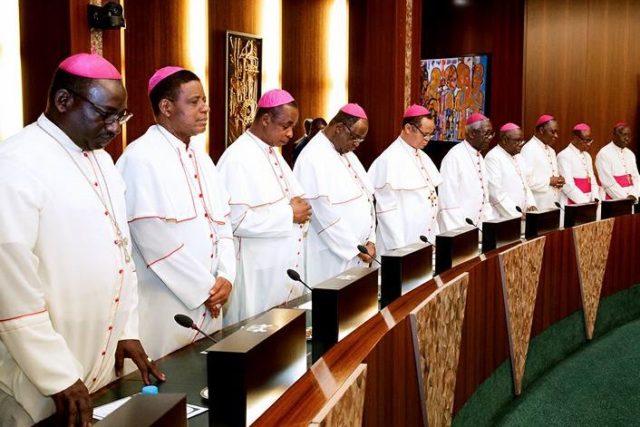
Catholic Bishops
Expresses deep concern over escalating insecurity, despite national security emergency declared by President Tinubu
The Catholic Bishops’ Conference of Nigeria (CBCN) has urged the Federal Government to adopt modern surveillance technology and end the delayed prosecution of terrorists.
They made this known in a communiqué issued and read by Most Rev. Peter Chikwe, the Bishop of Abakaliki, on Wednesday at the closing mass of their First Plenary Meeting for 2026 in Abuja.
The bishops expressed deep concern over escalating insecurity, despite the national security emergency declared by President Bola Tinubu.
While acknowledging the President’s order to recruit more security personnel and the intensification of military operations, the clerics noted that the nation remained gripped by “endless tears and grief.”
The bishops specifically cited the recent “gruesome massacre” of over 200 people in Woro and Nuku villages, Kwara, where both Christians and Muslims were killed by Islamist jihadists for resisting fundamentalist ideologies.
”In many parts of the country, particularly in the Northern region and the middle belt, we continue to see attacks involving students, pupils, and worshippers.
”Gunmen operate brazenly, freely, and unchallenged, leaving farmers unable to access their lands and thousands displaced from their homes,” the communiqué said.
The CBCN urged the Federal Government to prioritise the acquisition of drones and Artificial Intelligence (AI) to monitor remote mining sites, noting that proceeds from illegal gold and lithium mining were being used to fund terrorism.
They also noted that the perceived delay in prosecuting arrested terrorists, or the reintegration of “repentant” insurgents into security forces, created a dangerous impression of government complicity.
While welcoming the government’s decision to seek external assistance, the bishops maintained that the ultimate “security and destiny of our nation are in our hands.”
The bishops further called on the government to prioritise the “Common Good” by implementing urgent electoral reforms and ending systemic economic sabotage fueling insecurity.
The document, titled “Leadership for the Common Good,” warned that Nigeria’s democracy was being undermined by a “deep lack of trust” in government institutions and persistent voter apathy.
Regarding the 2027 general elections, the bishops demanded that the National Assembly mandate the real-time transmission of results from the Bimodal Voter Accreditation System (BVAS) to the INEC Result Viewing (IReV) portal.
”The recently concluded FCT elections fell to an abysmal seven per cent of registered voters, a strong indicator of increasing voter apathy.
“To save democracy, there is a need to respect the will of the people,” they said.
The conference announced a change in leadership, with Most Rev. Matthew Man-Oso Ndagoso, the Archbishop of Kaduna, elected as the new President of the CBCN.
Other elected officers include Most Rev. Alfred Adewale Martins (Vice President), Most Rev. Peter Odetoyinbo (Secretary), and Most Rev. Peter Chukwu (Assistant Secretary).
The communiqué was signed by the outgoing President, Most Rev. Lucius Ugorji, and the outgoing Secretary, Most Rev. Donatus Ogun.
The bishops noted that the 2026 Lenten season coincided with the Muslim Ramadan, describing it as a “divine invitation” for Nigerians of both faiths to live in harmony and work for a better society.
Despite the challenges, the clergy urged Nigerians not to give in to despair, asserting that “a better Nigeria is possible” if leadership prioritised service over sectional interests.
The plenary, which drew bishops from across the country, began Feb. 22 ended Feb. 25 with a communiqué on the state of the Church and the nation.