2027: Vice President won’t be ‘spare tyre’ in my govt — Peter Obi
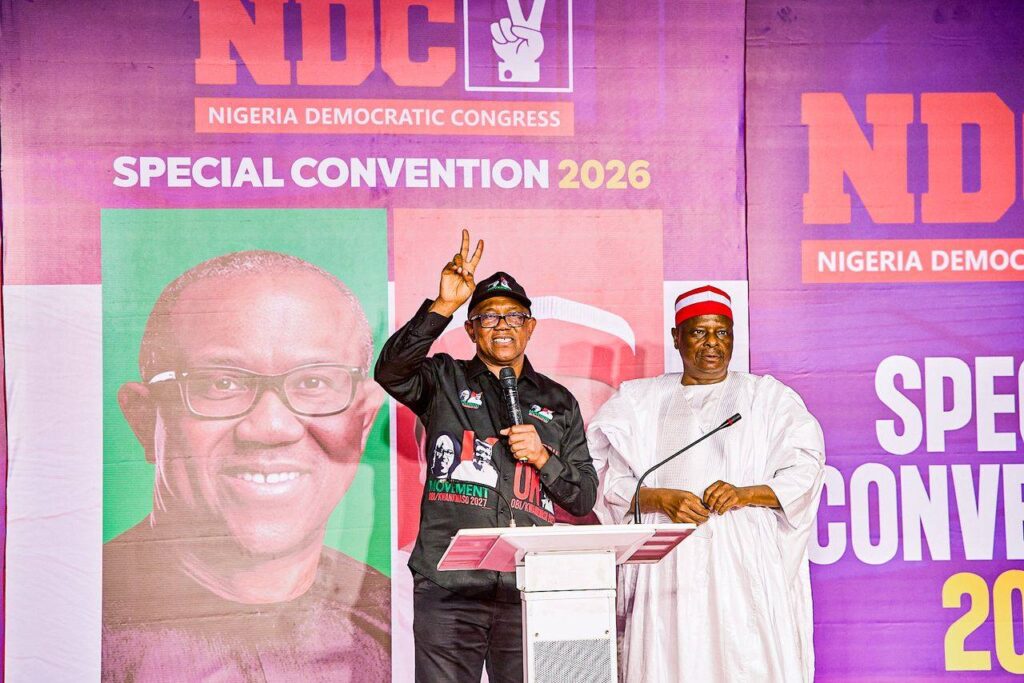
Obi and Kwankwaso
Pledges to increase Nigeria’s electricity generation, distribution by at least 10,000MW within four years
Presidential candidate of the Nigeria Democratic Congress (NDC) for the 2027 election, Mr. Peter Obi, has pledged to run an inclusive administration in which his running mate, former Kano State Governor, Rabiu Kwankwaso, would serve as a full partner in governance rather than a ceremonial deputy.
Obi made the declaration while accepting his nomination as the National Democratic Coalition (NDC) presidential candidate for the 2027 election, shortly after announcing Kwankwaso as his vice-presidential candidate on Saturday.
Obi said his administration would depart from what he described as a tradition of sidelining deputy leaders.
“The government we intend to form will no longer be a government where anybody will say that the vice president is a spare tyre.
“The vice president will be a partner because we want to build a nation where there are two equal people who work for the greatness of the country.”
”Decisions will be taken as partners. Everybody will be consulted. That is what we require, and that is how government functions,” Obi said.
The former Anambra State governor said the proposed arrangement reflects his commitment to consultation, shared responsibility and effective governance.
He subsequently invited Kwankwaso to join him on the ticket, describing the former Kano governor as a leader who shares his priorities on education and security.
“It is on this note that I graciously accept the affirmation as the candidate of this great party. And in the same spirit, I am inviting Dr Rabiu Musa Kwankwaso to join me as the vice-presidential candidate.
“He believes in education and security. And we will work together to ensure it happens,” Obi said.
Obi said the partnership would be anchored on a common vision for national development and a determination to address the country’s most pressing challenges.
Reaffirming his campaign message, he told supporters that “a New Nigeria is Possible,” adding that the political project was larger than any individual ambition.
“This pivotal moment transcends the individual ambitions of Peter Obi; it concerns the essence of our nation and the future of our children. It is about rekindling hope for millions who have faced adversity yet remain committed to Nigeria,” he said.
The presidential candidate also identified insecurity as a major threat to Nigeria’s progress, promising decisive action to restore public safety and confidence.
“We must address insecurity with resolve and urgency, for no nation can thrive while its citizens live in trepidation”
”The primary responsibility of the government is to ensure the safeguarding of lives and property,” Obi said.
He recalled Nigeria’s historic contributions to international peacekeeping operations, noting that the country’s armed forces once earned global recognition for their leadership and effectiveness in missions across Africa and beyond.
According to Obi, restoring security, strengthening institutions and fostering national unity would be among the central goals of the administration he hopes to lead alongside Kwankwaso.
He pledged to deploy intelligence-driven and technology-based approaches to tackle insecurity, while addressing root causes such as poverty, unemployment and social exclusion.
A key highlight of his address was his promise to overhaul the power sector, which he described as central to economic growth and industrial development.
“Nigeria today is the nation with the highest number of citizens lacking access to electricity globally,” he said.
He noted that Nigeria generates and distributes about 4,000 megawatts of electricity for a population of over 200 million people, describing the figure as inadequate.
Comparing Nigeria with countries such as South Africa and Egypt, which generate over 40,000 megawatts in spite of smaller populations, Obi said the gap reflected a major structural challenge.
“Over the next four years, I commit to ensuring a minimum of 10,000 megawatts increase in power generation and distribution,” he said.
He also promised to strengthen the healthcare system, including increasing health insurance coverage from about 10 per cent to over 20 per cent within four years.
According to him, his administration would raise healthcare spending to at least 10 per cent of GDP and ensure that every one of Nigeria’s 8,809 political wards has a functional primary healthcare centre.
On education, Obi pledged increased investment in schools, teacher training, technology and vocational skills development, saying human capital is the foundation of national transformation.
He expressed concern over rising food insecurity, noting that over 35 million Nigerians are projected to face acute hunger in spite of the country’s agricultural potential.
“We have absolutely no justification for being among the world’s hungriest nations,” he said, adding that his government would prioritise agricultural productivity to shift Nigeria from consumption to production.
Obi also promised targeted support for micro, small and medium enterprises through tax incentives, access to affordable credit and job-creation policies aimed at empowering young Nigerians.
Earlier, NDC National Leader, Sen. Seriake Dickson, presented the party’s flag to Obi, describing it as “a symbol of victory for Nigerians”.
The National Chairman of the party, Sen. Moses Cleopas, said the NDC had recorded significant growth within three months of its registration and was positioned to offer Nigerians a credible alternative ahead of the 2027 polls.