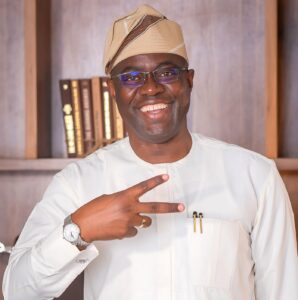
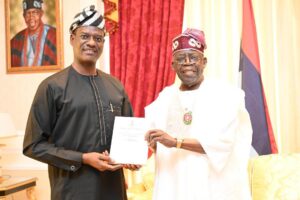
Okpebholo and Oshiomhole
How EDSG is tackling failed portions of state, federal roads in Edo
BY TITUS AKHIGBE, BENIN
Following public outcry over the failed portions of roads in Edo, especially Benin-Agbor and Benin-Sapele roads tagged federal roads, Governor Monday Okpebholo has shown commitment on the rehabilitation and construction of both state and federal roads.
The failed portions of roads across Edo State did not begin with the administration of Senator Okpebholo. For years, residents, motorists and visitors travelling through the state have experienced the challenges posed by deteriorating roads, some of which connect Edo with neighbouring states.
As a candidate of the All Progressives Congress (APC), Okpebholo recognised the scale of the problem and made the rehabilitation of roads one of his major campaign commitments. He promised to confront the state’s infrastructure deficit and improve road connectivity if elected governor.
Since assuming office, his commitment to road infrastructure has been evident in the administration’s focus on the rehabilitation and reconstruction of both state and federal roads. His approach has been to address the practical needs of residents rather than dwell on which level of government has responsibility for a particular road.
It will be recalled that during his inauguration speech at the Samuel Ogbemudia Stadium on Nov. 12, 2024, Okpebholo said: “Our policy to develop road infrastructure is targeted at constructing roads, drainages and bridges, to ease transportation for all.”
The administration began implementing that commitment almost immediately after taking office, with attention directed to some of the state’s most difficult road corridors.
Roads, drainages and bridges have remained central to the administration’s infrastructure agenda, with the broader objective of improving movement between rural and urban communities, strengthening economic activities and making it easier for residents to connect with neighbouring states.
Speaking on the ongoing rehabilitation and construction of failed portions of roads in Edo, the Chief Press Secretary to the Governor, Dr. Patrick Ebojele said, “Since taking office, the governor has inspected several road projects across Edo South, Edo Central and Edo North. Some damaged sections have been rehabilitated, while others have undergone reconstruction. The interventions have improved access to communities and reduced some of the difficulties previously faced by motorists and other road users.
However, the administration’s road projects have also attracted criticism. Some critics have continued to circulate images and short videos showing failed sections of roads across the state, particularly on major federal corridors. While highlighting areas that still require attention is legitimate, such reports can create an incomplete picture when ongoing and completed interventions are left out.
A recent focus on damaged portions of the Benin-Agbor road, for instance, has generated public debate over the condition of federal roads in Edo. But the Benin-Agbor corridor is not the only major federal road in the state, and the administration has also intervened in other roads outside its direct statutory responsibility.
The Benin-Sapele Road provides an example. For years, motorists using the road complained about its deplorable condition. Under the previous administration, the fact that the road was a federal road was frequently cited as a reason for the state’s limited involvement.
According to Ebojele, “the Okpebholo administration has adopted a different approach irrespective of ownership. Edo residents are the people who use the roads and bear the consequences when it becomes impassable.
“The Edo State Government has therefore collaborated with the federal government under President Bola Ahmed Tinubu on the rehabilitation of the Benin-Sapele Road. More than 23 kilometres of the road is being addressed with concrete pavement designed for long-term durability, with completed sections already providing relief to motorists.
For residents and businesses along the corridor, the intervention is about more than road construction. A functional road means shorter travel times, lower vehicle maintenance costs and easier movement of goods and people.
The Benin-Sapele Trunk A Road is also an important transportation corridor serving the economic interests of communities across Edo and the Niger -Delta. Its rehabilitation therefore has implications beyond the immediate communities along the route.
Motorcycle riders and commercial drivers, who previously spent hours and significant amounts of money on repairs say the improved road has reduced their maintenance burden.
A motorcycle rider popularly known as an “okada rider,” Simeon Yohana, said the intervention had brought relief to riders who frequently repaired their motorcycles because of the poor condition of the road.
“I have been working here for some years now. The road was bad and we constantly repaired our bikes. But now, we don’t repair our bikes as often and we are able to take more money home,” he said.
A commercial driver, Michael Uweugbe, also commended the governor’s intervention. “He has done very well on this road. The improvement cannot be compared with what we had before. The road is much better now,” he said.
Another road user, Osagie Isibor, recalled the difficulties motorists faced when the road was in poor condition. According to him, the previous administration often reminded residents that the road belonged to the federal government. “Governor Okpebholo came and, instead of making excuses, intervened. We are now enjoying the road,” he said.
Isibor, however, urged the state government to extend similar intervention to the Benin-Agbor Road. “You could hardly drive on this road when it was bad. The governor’s intervention helped solve the problem here. We are appealing to him to move to Benin-Agbor Road and do the same thing,” he said.
At the Ogheghe Motor Park on the Benin-Sapele Road bypass, the improvement in the road has also been welcomed by transport operators.
The park chairman, Faith Imadonmwinyi, said businesses had improved after years of difficulties caused by the poor state of the road.
“We are happy with the outcome of the Benin-Sapele Road. It is very motorable now compared with what we had before,” he said.
“About two years ago, the road was very bad and almost impossible to use. We had to pass through communities to avoid the bad sections and reach our destinations. Now the road is better, and we can drive with greater peace of mind.”
Beyond the Benin-Sapele corridor, the broader road challenge in Edo remains significant. The state has a large network of roads, including federal, state and local roads, and no single administration can address every failed section at once.
Parts of the metropolitan and state road network are being handled through state interventions, while federal authorities and the Niger Delta Development Commission (NDDC) are also involved in the assessment and reconstruction of adjoining failed sections, including stretches around the Ologbo and Amukpe axes.
The important point is that the condition of Edo’s roads should be assessed on the basis of both what remains to be done and what has already been done.
Continuing, the Chief Press Secretary to the governor said, “Criticism is part of public accountability, and the Okpebholo administration should continue to be challenged wherever roads remain bad or projects are delayed. But criticism should also acknowledge measurable progress where it exists.
“For an administration that came into office with road infrastructure as one of its stated priorities, the rehabilitation and reconstruction of key road corridors remain an important part of its record.
“The road projects may not have solved every transportation challenge in Edo State, but the improvements already recorded on some major corridors demonstrate the potential impact of sustained investment in infrastructure.
Ultimately, what matters most to the people is not the political argument over who owns a road. The people want roads they can travel on safely at all times to allow businesses and communities to function without hitch.
A school of thought however believes that the governor’s prompt intervention should be the standard by which the Okpebholo administration’s road infrastructure programme should be judged.