Emerging menace to Nigeria’s democracy called ‘Data Boys’
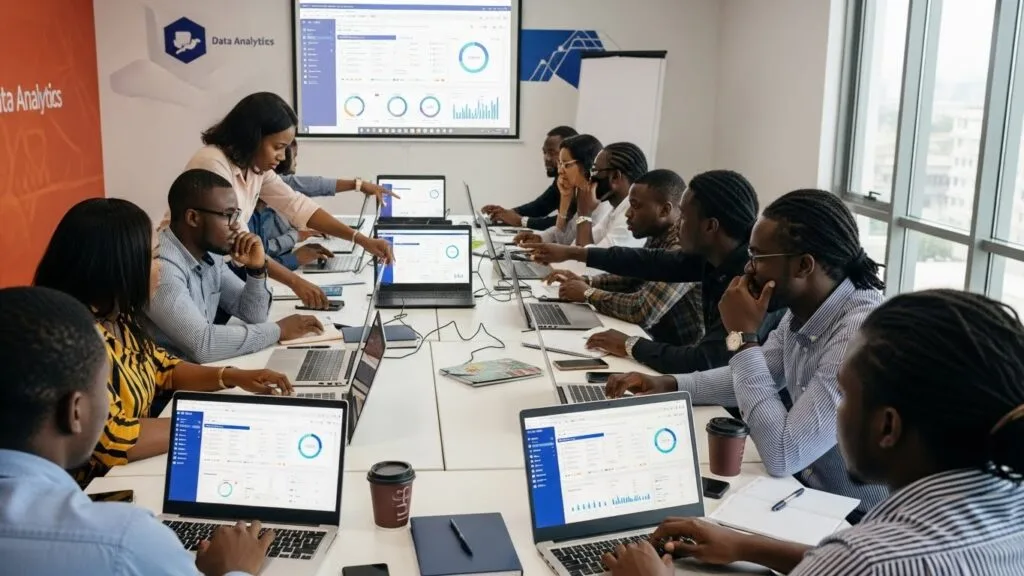
Computer savy youths
*Who they are and how they operate
BY TOSIN ADAMS & CHUKWUDI ABONYI
In Nigeria’s rapidly evolving digital landscape, a new breed of political operative has emerged, ostensibly called the ‘Data Boys’. Far from being a technical analyst or a legitimate statistician, the term has become a colloquialism for digital mercenaries and state-sponsored trolls who weaponise social media to manufacture consent, intimidate opposition or rivals and distort public discourse.
The Daily Monitor notes that as Nigeria navigates its journey toward democratic consolidation, the rise of these ‘Data Boys’ represents a sophisticated menace that threatens the very fabric of electoral integrity.
The ‘Data Boy’ is typically a tech-savvy youth, often an influencer or a social media “heavyweight” with a significant following on platforms like X (formerly Twitter), Facebook, and TikTok. Their primary utility is not governance, but perception management. In an environment where truth is increasingly elastic, Data Boys are hired to serve as the vanguard of a politician’s ‘Media Wing’. Their operations go beyond simple campaigning; they engage in “influence operations” that involve, narrative rehabilitation and scrubbing the image of controversial politicians.
They often use doctored graphs and alternative facts to convince a hungry populace that the economy is booming.
Often, they launching coordinated online attacks against critics, activists, and opposition candidates.
The hiring of Data Boys is rarely done through a formal human resources department. Instead, it follows a clandestine pipeline that bridges the gap between the corridors of power and the streets of the internet.
Political parties and “Situation Rooms” continuously monitor the digital space to identify users who possess “networked communicative power.” They look for individuals who can move trends or whose posts consistently garner high engagement. Those who are already vocal—either for or against the government—are often approached.
Recruitment often happens through intermediaries or “Political Aides” who serve as handlers. A “Data Boy” might be invited to a high-end hotel in Abuja or Lagos, where they are briefed on the “project.” In some cases, established influencers are co-opted; in others, promising accounts are “bought” or managed by a central hub—essentially a Nigerian version of a troll farm.
A data boy who spoke to our correspondent under anonymity said their renumeration is regular and depends on how highly rated one is. He said, “once you are approached and hired, you are onboarded on a WhatsApp group or Telegram App, where instructions on what to do are often dropped. Once the coordinator of your cell instructs that you jump on any particular post to either condemn or praise it, everybody swarms to the post and does so. There is usually an instruction on what everyone should do at any particular point in time.”
He was asked if there was job satisfaction in being a data boy, he said none, save from availing them stipends to depend on. “Bulk of the money goes to those up there, but down the ladder, it begins to shrink and some people get as low as N20,000 a month. It is not what one can depend on. But there are often verbose promises that a list was being compiled to give one a job in the civil service. But that is always in the pipeline.”
The remuneration for Data Boys is as varied as their tactics, ranging from immediate cash infusions to long-term career elevation.
For the rank-and-file digital foot soldiers, payment is often a monthly stipend, colloquially referred to as “the alert.” These payments are frequently made in cash or through untraceable transfers to avoid the prying eyes of anti-graft agencies. During peak election cycles, a high-level Data Boy can earn millions of Naira for a single coordinated “trend” or a successful character assassination campaign.
Beyond the immediate cash, there is a “LIFESTYLE” component:
Often, they are also providing high-end smartphones, laptops, and unlimited data subscriptions to ensure 24/7 connectivity.
High-performance vehicles, all-expenses-paid trips, and luxury hotel stays are common “incentives” for loyalty.
The most successful Data Boys view their work as a ladder. In recent Nigerian history, several prominent digital activists have been “settled” with official government appointments as Special Assistants (SAs) or Senior Special Assistants (SSAs) on New Media. This effectively integrates them into the state machinery, where their propaganda is now funded by taxpayer money.
Of course, the danger of the Data Boy phenomenon lies in the erosion of trust. When every statistic is viewed as doctored and every voice of support is seen as “paid for,” the space for genuine civic dialogue disappears.
In a country with high youth unemployment, the “Data Boy” role is one of the few viable “jobs” available. This exploits the desperation of the youth, turning the most creative minds of a generation into tools for democratic backsliding.
Through doxxing and coordinated bullying, Data Boys make the digital space “hot” for ordinary citizens who wish to hold the government accountable. This leads to self-censorship and a “spiral of silence.”
By using bots and multiple accounts to amplify specific hashtags, they create a “false majority.” This can mislead international observers and the domestic electorate into believing a candidate or policy has more support than it actually does.
The “Data Boy” is the modern evolution of the “political thug.” While the thugs of the 1990s carried machetes and snatched ballot boxes, the Data Boys of the 2020s carry smartphones and hijack narratives. As Nigeria approaches future electoral cycles, the challenge will be to distinguish between legitimate digital advocacy and the manufactured noise of the “Data Boy” industry. Without robust digital literacy and a crackdown on the illicit funding of disinformation, the “Data Boy” may well become the architect of a “post-truth” Nigerian democracy.