Executive Order 9: FG begins direct remittance of oil revenues to FAAC
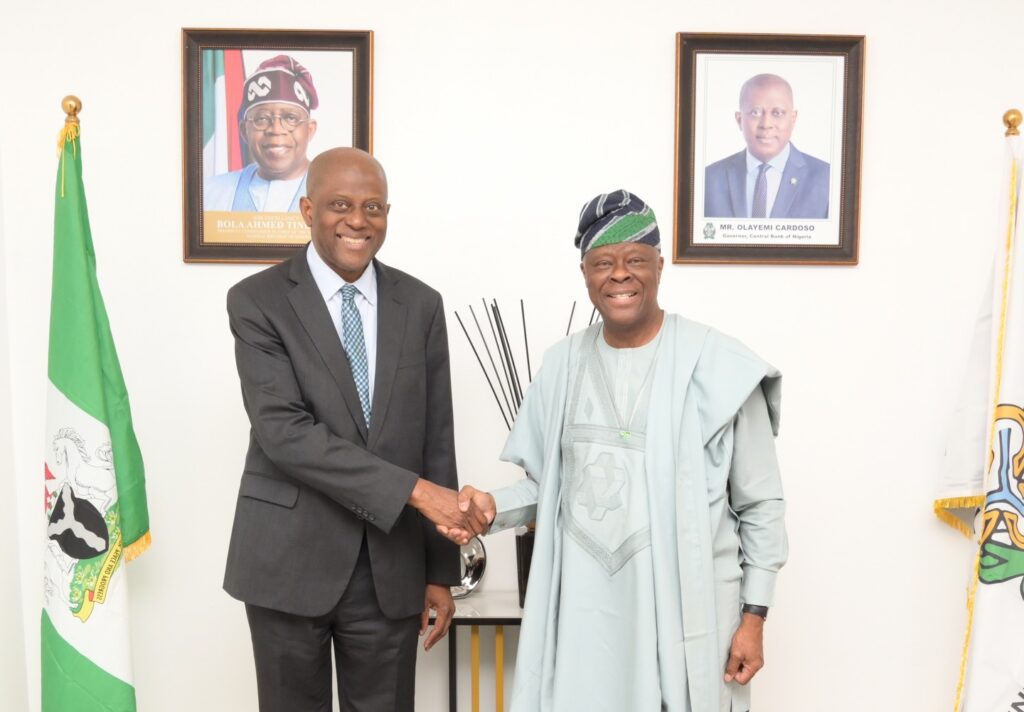
Cardoso and Edun
NGF backs FG’s directive, says move vital step towards strengthening fiscal transparency, predictability
The Minister of Finance and Coordinating Minister of the Economy, Wale Edun, on Monday, disclosed that the Federal Government has commenced the implementation of Executive Order 9 of 2026, which mandates the direct remittance of oil revenues to the Federation Account Allocation Committee.
The Minister revealed this in a statement issued on Monday, detailing key resolutions reached at the meeting.
This followed the directive of President Bola Tinubu on the remittance to FAAC and the inaugural meeting of the implementation committee for the executive order.
Edun said the committee reaffirmed the President’s directive that revenues accruing to the federation from petroleum operations must be managed in line with constitutional provisions and in a way that safeguards funds meant for the three tiers of government.
“In line with the President’s directive, NNPC Limited shall cease, with immediate effect, the collection of the 30 per cent management fee and the 30 per cent frontier exploration fund deductions from profit oil and profit gas under Production Sharing Contracts.
“Additionally, all remittances of gas flare penalties into the Midstream and Downstream Gas Infrastructure Fund (MDGIF) are suspended with immediate effect, in line with the Executive Order,” the statement read.
On Section 2(3) of the order, which provides for direct payments by contractors into the federation account, the minister said the committee agreed that the transition must respect existing contractual and financing arrangements while maintaining investor confidence.
“For this reason, the Committee approved a defined transition period for the operationalisation of direct payments by contractors of profit oil, royalty oil, and tax oil into the Federation Account.
“Until the Committee issues detailed guidelines, contractors will continue to remit under the current process. During the transition period, the Committee will issue clear, standardised guidance to ensure an orderly changeover,” the statement added.
He further disclosed that the committee approved the establishment of a technical subcommittee to develop detailed transition guidelines within three weeks and to commence a review of the Petroleum Industry Act to address structural and fiscal anomalies affecting federation revenues.
“The Technical Subcommittee will be led by the Special Adviser to the President on Energy, and will include the Solicitor-General of the Federation and Permanent Secretary, Federal Ministry of Justice, the Chairman of the Nigeria Revenue Service, and the Chairman of the Forum of Commissioners of Finance, representatives of the Minister of State Petroleum Resources, Oil, with secretarial support from the Budget Office of the Federation,” it said.
The minister added that the committee would continue to provide coordinated guidance and timely updates as implementation progresses.
Meanwhile, the Nigeria Governors’ Forum (NGF) has expressed its support for the recent federal reforms mandating that all Oil and Gas revenue entitlements be remitted directly into the Federation Account.
The forum’s Chairman, Governor AbdulRahman AbdulRazaq of Kwara State, expressed the support in a statement by Yunusa Abdullahi, Director of Media and Strategic Communications for the NGF, in Abuja on Monday.
AbdulRazaq described the move as a vital step towards strengthening fiscal transparency, predictability, and constitutional alignment across the three tiers of government.
AbdulRazaq lauded Executive Order 9, signed by President Bola Ahmed Tinubu on Feb. 13, 2026.
The order directed the realignment of oil and gas revenue flows—including royalty oil, tax oil, profit oil, and profit gas—to ensure they conform to constitutional provisions.
According to AbdulRazaq, these reforms are essential for clarifying regulatory mandates within the petroleum sector and ensuring that the Federation Account remains the “backbone of Nigeria’s intergovernmental fiscal system.”
“As a non-partisan body representing the 36 State Governors of the Federation, the NGF underscores that the integrity and predictability of Federation Account inflows are foundational to Nigeria’s fiscal federalism.
“Oil and gas revenues remain a central component of the distributable national income.
“The clarity, transparency, and predictability of those inflows directly affect capital planning, debt sustainability, infrastructure delivery, and public service provision at the federal, state, and local government levels,” he said.
AbdulRazaq stated that recent Federation Account Allocation Committee (FAAC) communiqués had consistently demonstrated a gap between gross revenue collections and final distributable sums.
He said that for the subnational governments, it wass the latter that determines fiscal capacity.
“When remittance pathways are layered, complex, or difficult to reconcile, fiscal predictability weakens, and that directly affects capital planning cycles across the Federation at federal, state, and local government levels.
“Nigeria’s population now exceeds 220 million and continues to grow rapidly. States sit at the frontline of delivering education, primary healthcare, infrastructure, security architecture, and economic opportunity to this expanding population.
“Predictable revenue flows strengthen the ability of states to meet these obligations responsibly,” he said.
Commenting on the development, AbdulRazaq emphasised the link between revenue clarity and public service delivery.
“Structural clarity in the remittance of nationally owned resources strengthens fiscal stability across all tiers of government.
“Predictability improves planning. Planning improves delivery.
“The Governors’ Forum supports reforms that enhance transparency and strengthen the collective capacity of governments to meet the needs of our growing population,” AbdulRazaq said.
With Nigeria’s population now exceeding 220 million, he said that states are at the frontline of providing essential services such as primary healthcare, education, and security.
He added that predictable revenue flows were necessary for states to meet these obligations responsibly.
He also said that sustainable economic growth requires strong institutions, disciplined revenue management, and alignment between policy intent and operational execution.
He reaffirmed the governors’ commitment to collaborating with the Federal Government to ensure fiscal reforms result in tangible development outcomes for all Nigerians.