NDDC and the new language of development
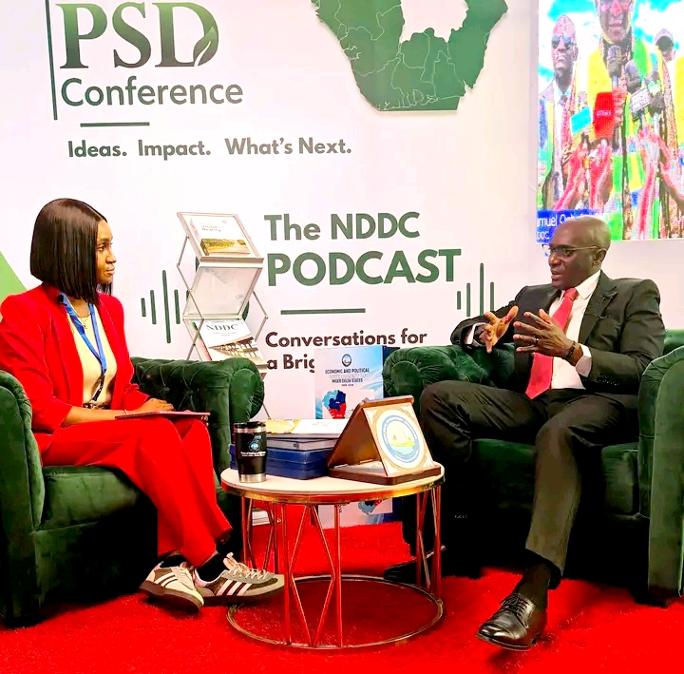
NDDC Podcast
… Communicating the Niger Delta through results
By Jerome-Mario Utomi
Development is often communicated through speeches, policy documents and official pronouncements. But in the Niger Delta, where decades of infrastructure deficits have shaped public perception of government intervention, development is perhaps communicated most convincingly through what communities can see, touch and use.
This appears to be the emerging philosophy of the Niger Delta Development Commission (NDDC) under the leadership of its Governing Board Chairman, Mr. Chiedu Ebie, and Managing Director, Chief Samuel Ogbuku.
The message from the Commission is increasingly straightforward: development must be visible, measurable and capable of changing everyday life.
For Ebie, the philosophy begins with understanding the NDDC’s proper place within the architecture of governance. At the commissioning of projects in Okrika, Rivers State, he stated that the Commission is “not a tier of government,” but an interventionist agency whose responsibility is to complement the efforts of the Federal, state and local governments.
That distinction is important. It frames NDDC’s development intervention not as competition with governments, but as collaboration. In Ebie’s words, “We believe in support, collaboration and the prayers of everybody.”
This philosophy is being translated into physical infrastructure.
Across the region, projects completed or commissioned under the present leadership provide some of the clearest evidence of this approach. Among them is the 27.5-kilometre Ogbia-Nembe Road in Bayelsa State, constructed in partnership with Shell Petroleum Development Company. The road includes seven bridges and 50 culverts and connects 14 communities. In Akwa Ibom State, the Commission completed the 6-kilometre Iko-Atabrikang-Akata-Opulom-Ikot Inwang-Okoroutip-Iwochang Road and the 600-metre Ibeno Bridge. In Abia State, it commissioned the 9-kilometre Obehie-Oke-Ikpe Road.
Electricity has also become part of this development communication. The 45-kilometre double-circuit 33KV feeder line from Omotosho Power Station to Okitipupa in Ondo State was commissioned, while a 1×15MVA 33/11KV electricity injection substation was inaugurated at Amufi in Edo State. The Okitipupa intervention was reported by the Commission as providing electricity to communities that had experienced prolonged darkness.
In Rivers State, the NDDC commissioned a 9.4-kilometre Ogu Community Road Network and a 1,500-seater Royal Hall in January 2026. The road includes extensive concrete drainage infrastructure and connects communities within Ogu-Bolo. The scale and physical character of the intervention prompted the FCT Minister, Nyesom Wike, to remark that he was impressed by the network of concrete roads and their impact on Ogu.
But the Commission’s development communication is not limited to roads, bridges and electricity.
Ogbuku has repeatedly presented a philosophy of moving from unfinished promises to completed projects. In April 2026, he told a retreat of regional development commissions that President Bola Tinubu had charged the NDDC to “complete all legacy projects for the benefit of the people of the Niger Delta region.”
That commitment is visible in the Commission’s renewed emphasis on legacy infrastructure, including the Kaa-Ataba Road and Bridge, Bonny Ring Road, Okrika-Borokiri Bridge and regional healthcare infrastructure. The NDDC has also reported progress on the 70.75-kilometre.
Omadino-Okerenkoko-Escravos Road and bridges in partnership with the Delta State Government and Chevron Nigeria Limited.
Ogbuku’s language captures the communication strategy succinctly. At the commissioning of projects in Ogu, he said the NDDC was “spreading the good news” of the Renewed Hope Agenda through tangible results.
That phrase is significant because it shifts the burden of communication from publicity to performance.
The current leadership has also sought to communicate development through institutional reform. Ogbuku has spoken of moving the Commission from “transaction to transformation,” while the NDDC has introduced stronger corporate governance protocols, standard operating procedures, key performance indicators and reforms aimed at improving transparency and project delivery.
Ebie’s emphasis on governance complements this approach. At the 2026 Partners for Sustainable Development Conference, he highlighted the adoption of a new Standard Operating Procedure and Governance Advisory Policies designed to provide clearer rules for the Commission’s operations.
The result is a two-sided development narrative: Ebie provides the institutional and partnership framework, while Ogbuku drives the implementation and public delivery agenda.
Together, their message is that the Niger Delta should no longer be communicated merely as a region of environmental degradation, infrastructure deficits and abandoned projects. It should increasingly be understood through roads that connect communities, electricity that restores economic activity, bridges that open isolated areas, healthcare facilities that expand access, educational interventions that empower young people and partnerships that multiply the value of public investment.
Indeed, Ebie has recognised the importance of communication itself, describing the media as a critical stakeholder in advancing the development agenda of the region.
This is perhaps the most important evolution in the NDDC’s current communication strategy: development is becoming the message.
When a road is completed, a bridge opened, a community electrified or a long-abandoned project brought back to life, the project becomes both an intervention and a statement.
For a region that has heard many promises over the years, that distinction matters.
The credibility of the NDDC’s present narrative will ultimately be judged not by the volume of its announcements, but by the durability of its projects and the lives they transform. If the current emphasis on completion, collaboration, governance and measurable delivery is sustained, then the Commission may be doing more than communicating development.
It may be helping to redefine what development in the Niger Delta looks like—and, more importantly, how the people of the region experience it.